Six Players, Six Overs, Total Chaos — This Is the Format Cricket Fans Love
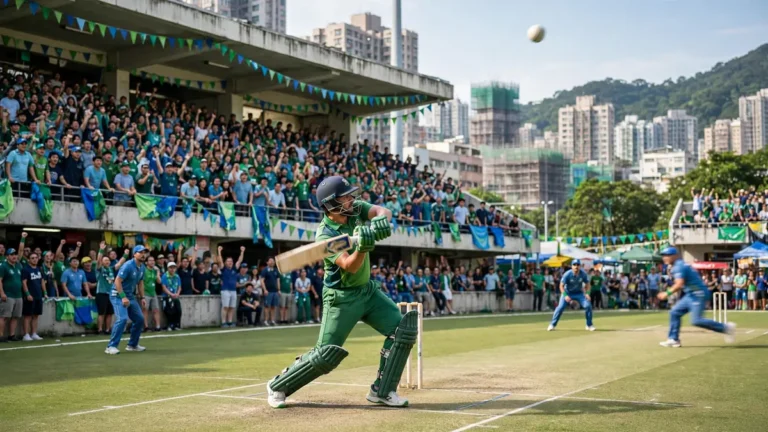
Forget everything you know about long cricket matches. The Hong Kong Sixes is cricket stripped down to its loudest, fastest, most entertaining parts — and it returns for its 22nd edition from 30 October to 1 November 2026 at the Tin Kwong Road Recreation Ground in Kowloon, Hong Kong.
Twelve international teams will take part, split into four groups of three. Defending champions Pakistan arrive as the team to beat, India return looking for only their second title, and the whole tournament is over in three days. Here is how the wild format actually works.
The basics: six-a-side, six overs
Each team fields just six players, and each innings lasts only six overs. That is it. A full match can be over in under an hour, which is why the tournament can pack nine group matches into day one alone.
With so few players, everyone has to contribute. There is nowhere to hide a weak batter or a bowler having a bad day. Every fielder except the wicketkeeper bowls an over, so captains cannot simply turn to one star bowler again and again — the whole side has to bowl, field and hit.
The rule that changes everything: retire on 50
The most famous Hong Kong Sixes rule is the retirement rule. A batter must retire not out on reaching 50 runs. It sounds strange, but it is what keeps the format fair and frantic at the same time.
Without it, one brilliant batter could bat through an entire innings and the match would be over as a contest. With it, teams need depth: after your star retires, the next batter has to keep the scoring going immediately. It rewards sides with hitting all the way down their tiny order, not just one hero.
It also creates wonderful drama. A batter racing towards 50 knows they are about to be forced off, so the final balls before retirement often produce the biggest shots of the match.
Groups, knockouts and finals day
The twelve teams are divided into four groups:
- Group A: Australia, England, Hong Kong, China
- Group B: Bangladesh, Scotland, Sri Lanka
- Group C: India, Pakistan, UAE
- Group D: South Africa, Afghanistan, Oman
Group winners go through to the Cup semi-finals, runners-up contest the Plate semi-finals and third-placed teams play for the Bowl. Saturday carries the last group matches and all six semi-finals, before finals day on Sunday, 1 November.
The finals run in order on Sunday: the Bowl final starts at 1:20 PM local time, the Plate final follows at 2:15 PM, and the Cup final — the match that decides the champions — is the last game of the tournament at 3:10 PM local time.
Why Pakistan vs India matters so much
Group C is the group everyone is talking about, because it puts defending champions Pakistan together with India and the UAE. Pakistan open against the UAE and then face India on day one, in the biggest match of the opening day.
Pakistan are the most successful team in the tournament’s history. They won last year’s title by beating Kuwait in the final, a record sixth Sixes championship, and they arrive as defending champions again. India, by contrast, finished 12th out of 12 teams last year and are chasing only their second Hong Kong Sixes title, their first having come back in 2005.
That contrast — the dominant champions against a side desperate to improve — is exactly why the format works for a tournament like this. In six overs, history counts for very little and one good over can beat anyone.
Where to watch
In India, the tournament will be streamed on the FanCode app and broadcast on the Sony Sports Network. In Hong Kong, matches are available on Cricket Hong Kong’s official YouTube channel and Facebook page, with other regions to be confirmed closer to the start.
Why fans love it
The Hong Kong Sixes is not trying to replace Test cricket or T20s. It is a festival format: big hits, fast games, a carnival atmosphere and a new champion crowned in a single weekend. Batters swing from the first ball, bowlers have to be brave, and no match is ever truly safe until the last over is done.
If you have never watched it, the Pakistan vs India clash on day one is the perfect place to start. Six players, six overs, one small ground — and total chaos, in the best possible way.



3 Comments